


Internet privacy is also known as online privacy and a part of data privacy. Basically means you are entitled to personal privacy when you provide your personal information on the internet, and it can be personally identifiable information (PII) and non-personally identifiable information, in other words, it can be your behavior on social media.
Do you actually know that whatever we provide on our social media such as Facebook, Instagram or Twitter profile has created an identity that can be capture or stolen in a short time frame?A report found that, 78% check for potential places through social media platforms and 74% uses Google Street View to find out the property before robbing your house!
Many hackers are actually tech-savvy thieves and money may not be their only motives. Some hackers motives is to attack their business or personal rivals, and some may even do it out of curiosity or for fun. So, with all these various motives, anyone of us could end up as a target.
How do hackers hack? They could simply use automated bots to gather websites for information and it is stated that almost 10% of all the website traffic is made up of automated bots. These hackers liberate bots to help with searching of websites for its weaknesses and exploit them.
So do you really want to share details such as your email address, birth date or contact number that hackers could easily gain access to change your password? Just so you would receive heartwarming birthday messages? I think it’s totally not worth the risk.
However, not all bots are bad. Businesses often use bots to stimulate interactions with people.
Here are three types of twitter bots:
- Scheduled bot – posting messages at a specific time. For instance, the Big Ben clock.

2. Watcher bots – observe other twitter accounts or websites to see if there are any changes.
3. Amplification bots – boost contents by liking and retweeting tweets sent by existing client that purchase their services and may boost client’s popularity just by retweeting their tweets.
So from here, it brings us to how many fake followers are there? As we all know that influencer with larger amount of followers enables brands that they work with to reach more people. Hence, it is reasonable that an influencer with more followers usually charge more for a post/advertisement. However, are those real or fake followers? Because as the social media industry grows rapidly, it is driving people to set up “follower bots” (a software that function for your account to follow, comment and even like other accounts automatically to gain attention). So, it is possible for some influencers to buy fake followers in order to increase their numbers so as to gain benefits and to be seen as popular. This is why brands are becoming more cautious when it comes to selecting influencer to recommend their products, because working with self-claimed influencers with no real audience can cause potential damage to a brand’s campaign.

A team at Mediakix has performed an experiment to prove that becoming a fake influencer is not difficult. The team created two fake accounts that has proven that they are able to gain a large amount of followers easily and how people could possibly do it with bad intention to commit influencer fraud. (FYI: these accounts are no longer exist.)
How do businesses/brands spot fake influencers?
1. Take a look at the engagement ratio with follower

Usually, fake influencers have low engagement rate with their followers taking into consideration that their huge follower count. You can simply just compare their engagement rate to their following size or use tools such as influencer fee to calculate for you. Fake followers usually does not engage with the content posted by influencers.
2. Analyze engagement quality
Go through the comments section of the influencer’s content, if the comments are mostly irrelevant to the post, especially generic comments such as “amazing shot”, “nice picture”, then there is chance most of them are fake bots or followers that left a comment.
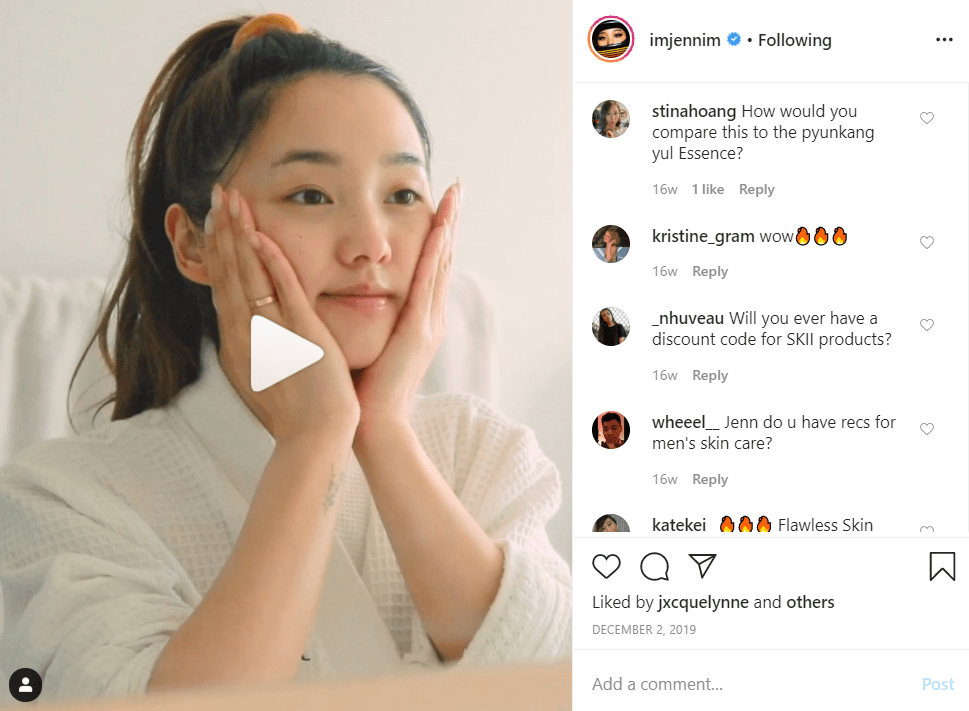
Above picture, is a good example of a real influencer with real followers. As you can see, the comments are relevant to the picture being shown and what more is followers prompt questions, instead of just emojis or generic comments.
3. A sudden increase in follower count
Another sign could be there is an unexpected spike in follower count, it could be resulted from bot accounts when people buy them to get more followers.

A sudden rapid increase of followers can be suspicious as most of the time, authentic influences gain followers at a steady growth and a decrease of follower once in a while.
Businesses/brands can use tools such as Creator Statistics Tool to examine the follower growth of potential influencer that they are considering to engage.
4. Analyze audience quality

Finally, the quality of an audience allows you to find out the legitimacy of their influence. There are tools like IG Audit to help analyze an Instagram account. For instance, it shows the estimation of real followers the influencer has.
In conclusion, there are so many things we need to know and learn about the internet now. It is critical for us to know the risk of sharing too much personal information and companies for identifying real prospects before working with them.
So what are your thoughts about sharing your personal profile online and influencer fraud? Do share with me in the comment section! 🙂
 Angela's Digital Marketing Blog
Hey Angela, great insights on bots and influencer fraud! As you have mentioned above there are some methods to identify whether Instagram users are getting fake followers, did you know about this video where many influencers were exposed for buying followers?! (https://www.youtube.com/watch?v=62JRlyaIlX4) I think influencers should be transparent and honest when engaging with their followers as it is unethical to buy followers just for the sake of making their profile appear as though there is a high engagement rate.
In my opinion, sharing personal information is extremely dangerous! Are you aware that anything posted online can never be permanently deleted! On the other end of the spectrum, how do you feel about businesses who misuse our personal information? There are many industries out there that require our personal information, especially the banking industry where money is involved. What measures do you think can be taken to prevent scams and frauds from happening?
LikeLike
yes!! I saw this video!! Many of my friends actually forwarded this video to me! I agree that influencers should be transparent and honest when engaging with their followers as their viewers would definitely appreciate their honesty and would most likely want to be kept updated with the influencer’s life. Personally, I feel followers and posts are just numbers. What really matters would be the content created and having it to make people keep wanting more!
As the saying goes, “digital footprint is permanent”. Information posted online can be searched, copied, and passed on so that it plays to a large invisible audience. Hence, people should take extra precautions when posting their personal information online. In my opinion, I feel that businesses who misuse personal information are so unethical and dishonest! Customers given them their trust yet they’re being betrayed! With many industries such as banks that requiring our personal information for their data purposes, I feel like it should be done directly at the bank. Some measures which can be taken into consideration would be keeping the PIN and passwords only to yourself. In addition, don’t give out account information over the phone or email. One important factor to bear in mind would be not to click links embedded in emails as it may be a phishing attempt.
LikeLike
Hi, i have learn many information about bots system and i also do believe not all bots are bad! Do you think most influencers in singapore are misusing the bots system to gain popularity?
LikeLike
Hi Junior! Glad that you’ve gained some knowledge here 🙂
I would not say that most influencers in Singapore are misusing, however, definitely there are influencers who uses unethical way to gain popularity.
There was a video of two poplar singapore’s influencer and youtuber Xiaxue and Deekosh whom reviews social media about influencers’ Instagram accounts for the likelihood of whether they had bought followers for their accounts.
They used an app called Social Blade, Xiaxue and Dee Kosh were able to track an Instagram account’s day-by-day growth and view a line chart of its monthly progress. You are able to see whether the followers are consistent and reasonable.
LikeLike
Hey Angela! Thank you for the insightful post that pointed out some of the issues that are ongoing in today’s world! One example of influencer fraud that I would like to share with you is about Lil Tay. I’m not sure if you have heard about her but she is probably the youngest sensation for all the wrong reasons! (https://www.scmp.com/culture/music/article/2144729/who-lil-tay-behind-illusion-nine-year-old-asian-rapper-and-internet) As shown in her instagram, most of her photos are posted with luxurious properties and cars. However, she doesn’t own any of them! Nonetheless, most of her followers are still updated with her life due to the contents she post. Isn’t it scary how easy it is to deceive people on the internet? You wouldn’t even know what is real or fake! What do you think companies can do before engaging influencers to market their product and prevent any backlash from it?
LikeLike
Hey Yui! Thanks for sharing with me an example of influencer fraud! Yessss it’s indeed very scary for people to deceive on the internet in order to gain benefits! Therefore, companies have to look into influencer’s account and analyze it before engaging them. For instance, companies can firstly see if there is a sudden spike in followers, unequal ratio of likes or comments to their number of followers, and check if the comments align with the post. These simple steps can help the company gauge whether the influencer is credible to work with.
LikeLike
Hey Angela! Thanks for sharing with us some tips on how to spot fake influencers! In my opinions, buying influencers may not be 100% unethical as it can act as a little support for them for the start to pull people to them, as the number grows, there will surely be real followers who really support them. What do you think?
LikeLike
Hi Xinyi! I do agree to a certain extent that buying followers can act as a little boost. However, this method is too dangerous especially if a company engage with these influencers to promote their products. If customers were to find out that the influencers are not credible, it may not only cause damage to the company’s reputation but also the influencer.
LikeLike
Hi! I think that while it is okay for businesses to utilize certain social media growth tools for marketing, it is wrong if they utilize the tools that will portray an inaccurate representation of the brand. For example, it is okay for brands to use scheduled bots to standardize posting times, but it is wrong for them to buy followers. Also, influencer fraud is an unfortunate reality in the business world, but I think with careful research on the brand’s part, they will be able to differentiate between fake influencers and real ones. What do you think?
LikeLike
Hi Charmaine, thanks for your comment! Yes, I think it is an unethical act to buy fake followers because if one day, the influencers were to be exposed, it will cause potential damage to the brand as well and the credibility of the person and the brand will be tarnished.
Brands have to do a thorough research about the influencer before engaging with them just by following the few steps listed in my post!
LikeLike